Power to Purslane and a Profesor


Purslane


You know that nasty weed that keeps popping up all over the garden? Well I ate it! Just so you know and in case you find me on the floor foaming at the mouth you'll know what to tell them in the ER.

Let me start at the beginning. I'm not much of a gardener but I do love growing things. A few months ago, I came across some packets of seeds that must have been at least 2 years old. I wasn't at all optimistic about them sprouting but on the off chance that they might, I planted them in some seed flats. After 3 weeks, I was very excited to see that my seeds had sprouted. Wow! I really did not expect it and so many of them too. Hoorah! I diligently watered my sprouts.

As time went by and the first true leaves started to form, I grew suspicious. My tomato seedlings looked the same as my eggplant, which looked a lot like my peppers and so on. Huh? Darn it! They were weeds and they were every where. They were in between my flowers, in my pots, in amongst my herbs . and even in the cracks of the garden path. Once a month I engaged in the seemingly pointless activity of pulling them out only to have them return - as weeds are want to do - winking at me with little, yellow-flower eyes.

One day I was hanging out on a recipe forum when a woman in France posted a photo of a lovely salad. I blinked twice and stared. The greens on her plate looked a lot like my weeds!

Holy Cow! I had an epiphany. I ran outside and looked at my weeds. Those yellow flowers winked at me but this time I winked back! Then I headed indoors to dream up recipes for their demise.

Three months later I still hadn't tried them. I wasn't brave enough. Two Caribbean plant books contained illustrated drawings and botanical descriptions of what looked like my weed. I read long winded descriptions of leaf shape and pattern, something about ovate, ovoid, spatulate leaves blah, blah, blah. There was a lot of 'to-ing and fro-ing' on my part, to the glossary and main text. Eventually I did what any right minded thinking person would do. I called a perfect stranger on a Sunday afternoon and asked. "There is a weed in my yard, can I eat it? "

Professor Julian Kenny is considered an authority on biodiversity in Trinidad and Tobago. He was a lecturer and Head of zoology in the faculties of Agriculture and Natural Sciences. The Professor doesn't know this but I am a huge fan of his due to all his efforts in conservation of the biodiversity in Trinidad and Tobago. No, we do know know each other unless that you count the fact that I sporadically read his articles in the newspaper.
chow ingredients


I am sure he must have thought I was crazy, ringing him up on a Sunday afternoon to say that I was eating weeds and thinking of feeding them to my family. I was nervous and I am sure barely coherent as I rambled on about doing research for an article. Yes, somehow my lowly blog got elevated into and article. I also mentioned not wanting to kill my children with a salad that I was making for dinner. Nice, I'm sure he thought I was a lunatic as well as rude. He must have been rolling his eyes skyward on the other end as he kindly directed me to make enquiries at the Herbarium at the University of the West Indies.
A week later I had my answer, my weed had a name. It was Portulace L. better known as Purslane or Pussley. A highly nutritious vegetable that is currently being touted as a superfood due to it's high Omega 3 content- the highest of any plant.

Sadly, in the Caribbean it seems that something has gone wrong with our food and it's culture of production that we could lose sight of such a lovely vegetable  in favour of foriegn imports. In most cases imported produce is harvested well before the food has developed peak flavour and will never ripen into anything but insipid tastestless of what it should really be. Purslane is currently an 'it' ingredient with chefs in Europe while our local population has lost all knowlege of it. I wonder if it is still a commonly used ingredient in other Caribbean islands? on the Caribbean as little as 20 years ago.

Here is the salad I made or rather I co-erced Mr H. into making for me. He's so supportive isn't he? Imagine making a salad that your wife foraged from the wild bushes in the yard. Now that's trust!I'm sur ehe must have been thinkinon the urging of your wife from

DSC_9042


In our society, foraging for food has become the most radical of acts seen as unessesary in an era of farmed and cultivated crops. The problem with this is thatIt is truly the only effective protest, one that can - and will - overturn the corporate powers that be. By the process of directly working in harmony with nature, we do the one thing most essential to change the world - we change ourselves. ~ Jules Dervaes ~

Bless

Farewell My Love

Photobucket

The last bag of mangos arrived via my dad. I was so excited that I did not notice until the following day that he was limping. It turns out he had climbed the mango tree to get the last ones which were in the topmost branches. He quickly sought to reassure me that he hadn't fallen out of the tree but had only slipped. This was said with the cheeky grin of an impish boy. There was a twinkle in his eyes that said he enjoyed shocking me by climbing trees at his age. Uhhmmm dad you are 72 years old! Too old to be climbing trees! I scolded, I preached, I ranted at his folly.

Seriously though who can resist the lure of a mangoes intoxicating perfume, the cherub yellow cheeks with just a blush of rose....like a babies cheek just made for biting. It's coming on to the end of the mango season. I is with a heavy heart that I am readying myself to say goodbye. I have have been cutting up and freezing them so that I can have some later on in the year. While doing so it struck me that I haven't done anything with my mangoes other than make baby food purée and greedily eat them just as they are for the past several months. Everyday I have had one for breakfast and the other as a snack as soon as I get home from work.
I know, I know terribly boring but I am of the view that there is no better way to enjoy mango than the way nature intended.
Photobucket
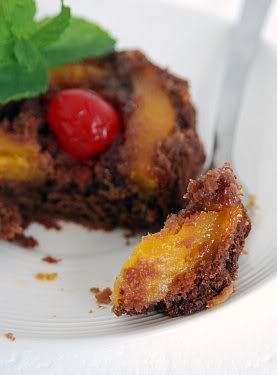
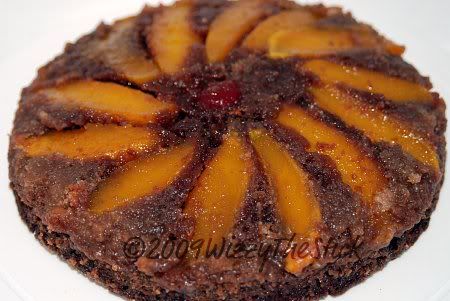
In the past I have tried various mango tarts and puddings. I can honestly say that I do not like the flavour and texture of a cooked ripe mango. The natural sugars concentrate to a cloyingly sweet mush. - bleh! What I needed was something to offset the overbearing sweetness of the cooked mango. I decided on a rich chocolate. It worked.

Mango Chocolate Gâteau
Mango Topping
ingredients
3 ripe but firm mangos (sliced as you prefer)
2 teaspoons lemon juice
1/4 cup butter
1/2 cup butter

Slice mango and sprinkle with lemon juice. Melt butter in a small saucepan. Add sugar. Spread the butter sugar mixture on the bottom of a round 9" cake pan. Arrange mango slices and pour cake batter on top.

Ingredients
cocoa powder for dusting cake pan
1 cup flour
1 cup sugar
1/4 cup unsweetened cocoa powder
1 teaspoon baking powder
1/4 teaspoon baking soda
1/4 teaspoon salt
3/4 cup buttermilk
1/4 cup shortening (melted)
1/2 teaspoon vanilla
1 egg


Instructions

In a bowl combine flour, sugar, cocoa powder, baking powder, baking soda, and salt. Add milk, cooled melted shortening and vanilla. Beat with an electric mixer on low speed till combined. Beat on medium speed for 2 minutes. Add egg and beat 2 minutes more. Pour into a greased and floured ( use cocoa powder in place of the flour) 9" round cake pan.

Bake in a 350 degree oven for 30 to 35 minutes or until a toothpick inserted in the center comes out clean. Cool on rack for 10 minutes. Remove from pan and cool thoroughly on a rack.


Photobucket
The End. There are no more mangoes.

say hello to pomme de cythere just commming into season. what can I say My love is fickle (smile0

http://carmensfamilyrecipes.blogspot.com/search?q=chocolate+cake

My little one is one

Photobucket

Admittedly this is the worst cake ever

A Tale of Whale

Photobucket


I have the dubious distinction of being the great grand daughter of a whaler. Dubious because it is now politically incorrect to even talk about killing whales. Yet at one time there were about ten commercial whaling stations operating in the Caribbean, in St. Vincent and the Grenadines, in Barbados, Trinidad and Grenada. Today under international agreement, Bequian whalers can harpoon no more than two whales per year. The whale is caught by traditional methods of hand thrown harpoons in small open sailing boats. The catch is not sold and is exclusively used for local consumption. It is given away to family and friends.

Photobucket
© 2009 All Rights Reserved, BDL&P

How does something like this end up on my breakfast table? Simple. The men in my family are mostly seamen with strong ties to the sea. I would not say that they are the romantic type -in fact just the opposite but for some reason they romaticize a meal of whale meat. These are taciturn men. Men who can spend all day looking out across the bay with a pair of binoculars without saying a word or it would seem moving an inch. They are men of slow grunts and uhhms for conversation. The ship captains among them have permanent squints from staring for hours on end at vast empty horizons. Apart from an almost a voyeuristic love of listening to VHF channel 16 and its call and distress conversations; silence and monotony are their thing. That is unless there is whale meat on the table. Then they come to life. They become animated. They trade stories about their adventures at sea. To hear them, you'd swear that they battled the beast themselves. And while they don't actually beat their chests and say Arrrg! As cousin A put it, " The way they carry on it's like, hoist the flag fellas we gah(got) whale!" You'd swear they sat in that boat themselves like the lateAthneal Ollivierre risking life and limb to bring it to the table.

I was to have broken that male seafaring tradition when as a teenager, I put to sea on my father's ship. At the time I was full of romantic notions (delusions:-) of being the first female ship captain in the family. Eight days later, somewhere off the coast of Jamaica with my last book read and nothing to do but cast about aimlessly in the 8 X 8 tin quarters of my room - that dream perished from the sheer boredom of life ( all eight days of unbroken monotony) at sea.

I would sit in silence on the bridge with the captain, my uncle V. A taciturn man of slow grunts and uhhms for conversation, But for explanations on how to read charts and plot a course (hopeless gibberish to me since I was flunking mathematics), there was a lot of silence and . I healthy 16 year old has an aversion to silence that and the knowledge that partying their summer away on some beach burned away Ahh yes my toothpick chewing Uncle V embodiment of the solitary sea dog. Lover of silence, vast endless horizons and voyeuerr of channel 16 Vhf call and distress radio conversations. That and the knowledge that my fiends were all partying on a beach somewhere, quick is the word I decided a life at sea was best left to the men and jumped ship in St. Lucia!


PhotobucketT Before you turn up your nosePhotobucket

As to the taste - meh. Nothing to write home about. But don't tell that to the older men for whom it's like har har ppound our chests Raise as one cousin put it it's more a psycological thing for the older men folk, it's like raise the flag we ga whale. It's smelly, oily. the blubber sits in the fridge waiting for someone to fall ill.

Nota Bene - Balls!

Photobucket
Back in July I spent the most fabulous, pampered and romantic holiday in Tobago. So this post was inspired by my memories of that trip and the taste of their most popular treat, Bene balls.

Photobucket

Bene is an African word for Sesame seed. I secretly call these Tobago Jawbreakers and they are my guilty pleasure. Considerable effort is required to bite into one; the old and infirm need not apply. Oh, but they are so good. Family and friends upon hearing of your intent to visit the island of Tobago will beleaguer you with requests to bring them some Bene Balls.

My stash from that July trip did not last very long and I decided I should try to make my own. It's super easy to do and I can't imagine why I never thought to make them before.

Photobucket
Trinibagonians abroad who can't get home and need a nostalgia fix. This is the real deal.

I was surprised that not one of my many Caribbean cookbooks had a recipe for this? Maybe it’s a Tobago national secret; a closely guarded formula like Angostura bitters? Never fear I finally wrangled an authentic recipe from a Tobagonian friend.


NB (Nota Bene): I have strayed away from the traditional ball shape and added honey so as to make it softer and more pleasantly crunchy. Your dentist will thank me I’m sure.


Photobucket
RECIPE INGREDIENTS:

1 cup sesame seeds

4 tablespoons packed light brown sugar

4 tablespoons honey

1. Line a 8 x 8 inch brownie pan with a sheet of waxed paper. Coat the waxed paper with cooking spray. Coat a silicone spatula with cooking oil spray. In a medium skillet, toast the sesame seeds over medium-low heat, stirring often, until they're fragrant and golden, 7 minutes to 10 mins

2. In a small saucepan, combine the brown sugar and honey. Cook over low heat, until the sugar is melted and the mixture is thick. No need to sir. Cook until the sugar reaches the soft ball stage. I keep a small bowl of water on the cook top to test the sugar. Use a teaspoon and drop a small amount of sugar in the water. Feel the sugar with your finger you should be able to roll it into a soft ball. At this point add the sesame seeds to the sugar and stir well with a wooden spoon.

3.Use the greased silicone spatula. Scrape the mixture into the brownie pan and onto the paper. Press down and smooth the mixture until it Is evenly spread across the bottom of the pan.

4. Cut the candy into 1-inch squares with a sharp knife. Let the candy cool completely. Break apart the pieces and store them in an airtight container at room temperature. Makes about twelve squares.

Photobucket


TIP: Another way to prepare these squares would be to coat two large sheets of waxed paper with cooking spray. Place one sheet of the waxed paper on a work surface, greased-side up. Scrape the mixture onto the paper and top it with the remaining sheet of waxed paper, greased-side down. Using a rolling pin, roll the mixture into a square about 1/4 inch thick.